
Accountability Over Convenience
How public servants and generative AI collaborate in creativity and innovation — a qualitative study of human–AI collaboration in the Norwegian public sector.
13
semi-structured interviews
3
Norwegian public organisations
4
main research contributions
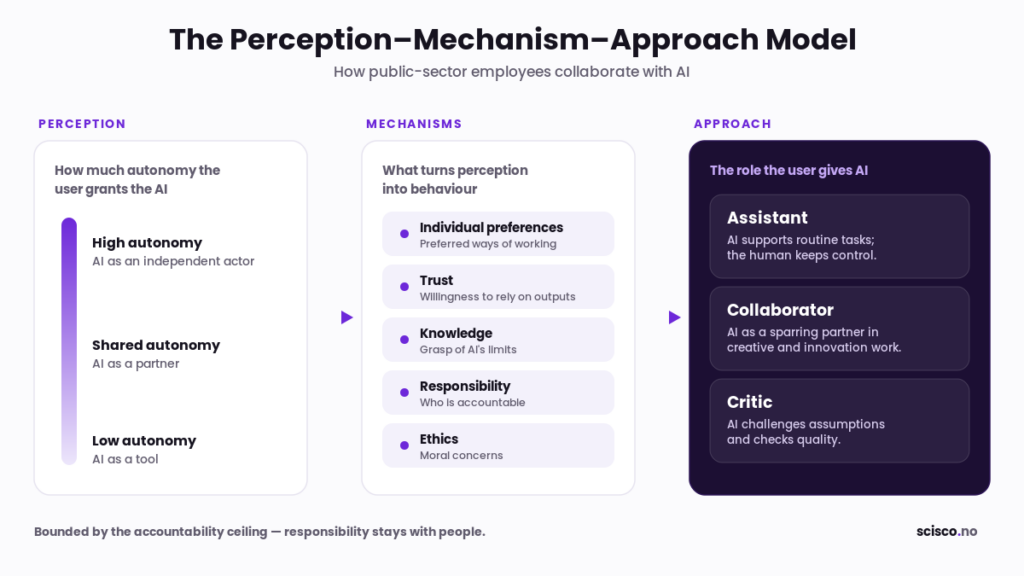
The Perception–Mechanism–Approach model
The thesis’s central contribution: a model explaining how an employee’s perception of AI — filtered through five mechanisms — shapes whether they treat it as an assistant, a collaborator, or a critic
Four Main Contributions
Perception–Mechanism–Approach model
How perceptions of AI autonomy — shaped by five mechanisms — lead people to treat AI as an assistant, collaborator, or critic.
The accountability ceiling
A structural limit on AI autonomy: because responsibility can’t be delegated to AI, humans must stay in charge of accountable decisions.
Evaluation is continuous
Working with AI turns idea evaluation into an ongoing loop rather than a final step — challenging traditional models of the creative process.
Managing premature convergence
A new creativity skill: resisting AI’s pull toward conventional answers to keep the idea space open.
Four Practical Recommendations
Create safe spaces for experimentation
Secure sandbox environments and non-sensitive test data let teams learn before scaling. Avoid experimenting on sensitive data.
Measure better outcomes, not just speed
AI often increases output rather than cutting workload — judge it on quality and better decisions, not time saved.
Invest in people, not just AI
Domain experts get the most from AI. Keep building expertise and train people to evaluate AI critically.
Protect human creativity
Start brainstorming without AI, bring it in once human ideas take shape, and challenge its first answers.
Frequently asked questions
What is the thesis about?
It examines how public-sector employees perceive and approach human–AI collaboration in creative and innovation work — based on 13 interviews across three Norwegian public organisations.
What is the “accountability ceiling”?
A structural limit on how much autonomy AI can be given, because responsibility for institutional decisions cannot be delegated to an AI system.
What methods were used?
A qualitative multi-case design: 13 semi-structured interviews across a municipality, a national agency, and a public broadcaster, analysed thematically.
Does it apply outside the public sector?
Yes — the perception-driven model and the accountability ceiling travel well to any organisation where someone must answer for AI-influenced decisions
Can I read or cite the full thesis?
The full write-up is available as an article, and the complete thesis will be available on request.
Want the full picture?
The full write-up goes deeper into the findings, the methods, and what they mean in practice — in the public sector and beyond.