
Accountability Over Convenience: How Public Servants Actually Collaborate With AI


Artificial intelligence is becoming part of everyday work faster than most organisations can absorb it. In the public sector, employees are already using generative AI to draft documents, summarise reports, generate ideas, and support decisions. But a question sits underneath all of that activity, and it rarely gets asked directly: when a public servant sits down to work with AI, what do they actually think they are working with — a tool, a colleague, or something else entirely?
For my master’s thesis in Industrial Economics and Technology Management (INDØK) at NTNU, I set out to answer that question. I conducted a qualitative study across three Norwegian public organisations — a municipality, a government agency, and a public broadcaster — and interviewed 13 employees with real experience using AI in creative and innovation work. What I found is that the technology matters far less than how people perceive it, and that the public sector faces a structural limit on how far AI can go that no amount of capability will lift.
Here are the main findings.
Perception comes first: the Perception–Mechanism–Approach model
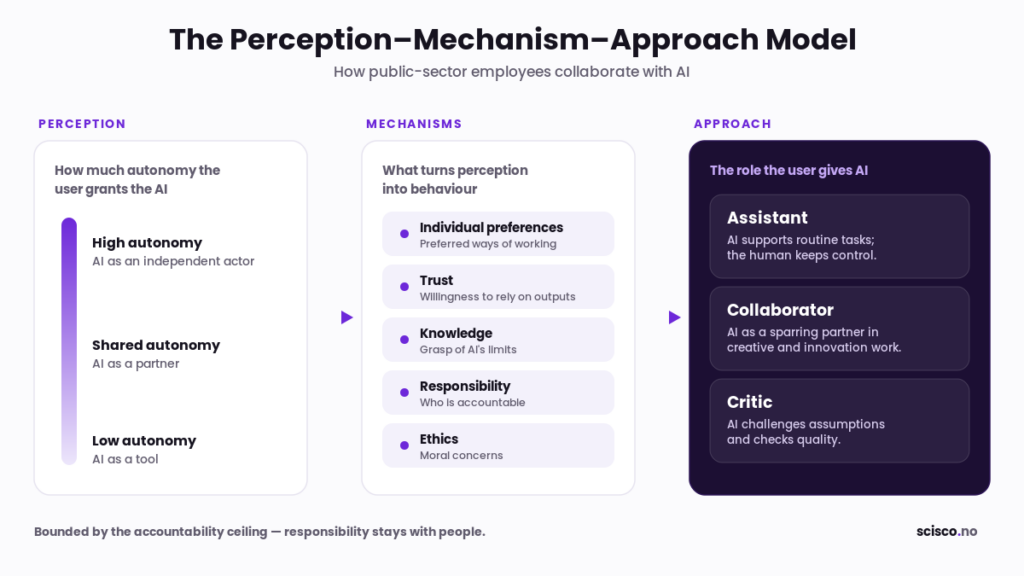
The central contribution of the thesis is a framework I call the Perception–Mechanism–Approach model. It explains how an employee’s mental picture of AI shapes the way they actually collaborate with it.
It works in three layers.
Perception determines how much autonomy a person grants the AI. This sits on a continuum:
- Low autonomy → AI is seen as a tool.
- Shared autonomy → AI is seen as a partner.
- High autonomy → AI is seen as an independent actor.
Mechanisms are the five factors that translate perception into behaviour. They explain why two people with access to the same model use it completely differently:
- Individual preferences — personal habits and preferred ways of working.
- Trust — willingness to rely on AI outputs.
- Knowledge — understanding of what AI can and cannot do.
- Responsibility — who is accountable for the decision or outcome.
- Ethics — moral concerns about using AI and its consequences.
Approach is the practical role the person ends up assigning to the AI:
- Assistant — AI supports routine tasks while the human keeps control.
- Collaborator — AI acts as a sparring partner in creative and innovation work.
- Critic — AI is used to challenge assumptions and check quality, not to generate ideas.
The important insight here is the direction of causation. It is not the model’s capability that decides how it is used — it is the user’s perception, filtered through those five mechanisms. Change the perception, and the collaboration changes with it.
Three ways people actually work with AI
When I applied the model to the interviews, three distinct pattern groups emerged.
Pattern Group A — the Assistant. These users perceive AI as low-autonomy and treat it as a supportive tool while retaining final authority. They use it to improve efficiency, organise information, and produce first drafts. This was the most common group. AI reduces the cognitive load of routine tasks — summarising a long report, for example — but it does not shape the creative direction of the work.
Pattern Group B — the Collaborator. These users perceive AI as having shared autonomy and treat it as a thinking partner. They work in iterative exchanges where both the human and the AI influence the result, using it for idea generation and rapid prototyping, then leaning on their own expertise to refine and challenge what it produces rather than simply accepting it.
Pattern Group C — the Critic. Represented by a single interviewee, this group also perceives AI as shared-autonomy but positions it as an impartial reviewer rather than a creative contributor. AI is used selectively to test assumptions, spot blind spots, and evaluate technical principles — and is deliberately kept out of the early inspiration stage to protect human-led creativity.
The value of these groups is practical: they give managers and teams a vocabulary for a conversation most organisations are not having. “How do you see AI in this task?” turns out to be a more useful question than “which tool should we buy?”
The accountability ceiling
The finding I keep coming back to is what I call the accountability ceiling — and I think it travels well beyond the public sector.
Because an AI system cannot be held legally, ethically, or professionally accountable, responsibility has to remain with a human employee. That creates a non-negotiable boundary: no matter how capable the system becomes, or how much a user trusts it, AI cannot operate independently where an accountable decision is being made. It can support and influence that decision, but it cannot be the decision-maker.
This is where the thesis title comes from — Accountability Over Convenience. There is often a convenient path where AI does more and humans check less. In institutional settings where someone must answer for the outcome, that path is closed off. The accountability ceiling therefore defines the maximum role AI can play, and it constrains how far AI-driven innovation can actually be implemented.
As agentic AI — systems designed to act more autonomously — moves from demos into real organisations, this ceiling becomes more relevant, not less. Autonomy is easy to grant in a sandbox. It is much harder where responsibility is real.
How AI reshapes creativity and innovation
Working with AI does not just speed up existing tasks; it changes the shape of creative and innovation work in ways that are easy to miss.
Evaluation becomes continuous, not final. In the classic creative process, you generate ideas and then evaluate them at the end. When people work with AI, evaluation happens throughout — they expand, test, and refine outputs in a constant loop. Judgement moves from a final gate to an ongoing activity.
AI supports the early stages, but not implementation. It accelerates ideation, drafting, and prototyping. It offers far less help with the hard part of innovation — getting an idea institutionalised, justified, and trusted inside an organisation.
Efficiency can quietly cost ownership. By removing the friction of the early, difficult stages of problem-solving, AI can weaken the sense of ownership, engagement, and motivation that people traditionally build by working a problem through from the start. That is a subtle trade-off worth watching.
Managing premature convergence is a new skill. Because AI tends to generate conventional solutions, users have to actively push for exploration and alternative perspectives to keep the idea space open. I’d argue this is becoming a genuine creativity-relevant competence in its own right.
Uncritical acceptance was rare. Contrary to a common worry in the literature, I found little evidence of people blindly accepting AI outputs. Accountability requirements and professional standards pushed employees toward continuous verification and human judgement.
“AI saves time” deserves a question mark. In practice, time gained through automation was often reinvested into more work or consumed by verification. AI tended to increase capacity and output rather than reduce workload — a distinction that matters a great deal for how organisations measure its value.
What this means for managers
Effective AI integration takes more than deploying a tool. Managers create the conditions that let employees work with AI safely, creatively, and responsibly. Four recommendations came out of the research.
1. Create safe spaces for experimentation. Employees need to explore AI without risking sensitive information or breaching regulations. Establish secure sandbox environments, let teams test on non-sensitive data, and encourage learning before scaling what works. Avoid experimenting on sensitive data.
2. Measure AI by better outcomes, not just faster work. Since AI often increases output rather than cutting workload, and verification is real work, don’t judge success by time saved alone. Evaluate it on quality, capacity, and better decisions. Avoid measuring success only by speed.
3. Invest in people, not just AI. Employees with strong domain expertise get the most from AI because they can catch mistakes, challenge outputs, and apply judgement. Keep investing in professional expertise, pair junior staff with experienced mentors, and train people to evaluate AI critically rather than accept it at face value. Avoid assuming AI replaces domain knowledge.
4. Protect human creativity. AI produces many ideas quickly, but they cluster around the conventional. Begin brainstorming without AI, introduce it once human ideas have taken shape, and encourage teams to push back on its first suggestions. Avoid starting every creative task with AI.
The pattern across all four is the same: AI delivers the most value when it complements human expertise rather than replacing it.
The takeaway
One message came through consistently across all 13 interviews: AI may change how we work, but people remain central to creativity, innovation, and decision-making.
That is not a comforting platitude — it is a design principle. The organisations that will get the most from AI are the ones that treat human perception, expertise, and accountability as the foundation the technology sits on, rather than obstacles to automate away.
I’m grateful to everyone who took part in the study for sharing their experiences so openly. If you’d like the detail behind these findings, you can read more about the thesis and its methods on the Thesis page — and I write regularly about human–AI collaboration, innovation, and technology strategy in the Articles section.