
Using AI as a Student: The Balance We Need to Get Right
I’ve been watching UnJaded Jade since I was 15 years old, revising for my IGCSE exams. Looking back, she’s been one of those creators who’s grown alongside me through different stages of education – from high school to university and now completing my master’s degree.
So when she released a video about AI in education, I was curious to hear her perspective.
What I liked most was that she didn’t tell students to avoid AI or encourage them to use it for everything. Instead, she asked a much more interesting question: How can we use AI without letting it do our thinking for us?
As someone who’s just spent the last year researching human-AI collaboration for my master’s thesis, I found that question incredibly relevant.
AI is an amazing tool. It can explain complex topics, generate practice questions, build revision schedules, summarize lecture notes, and even help overcome writer’s block. For students balancing deadlines, work, and life, that’s incredibly valuable.
The issue isn’t whether AI is useful, it clearly is. The issue is knowing where to draw the line.
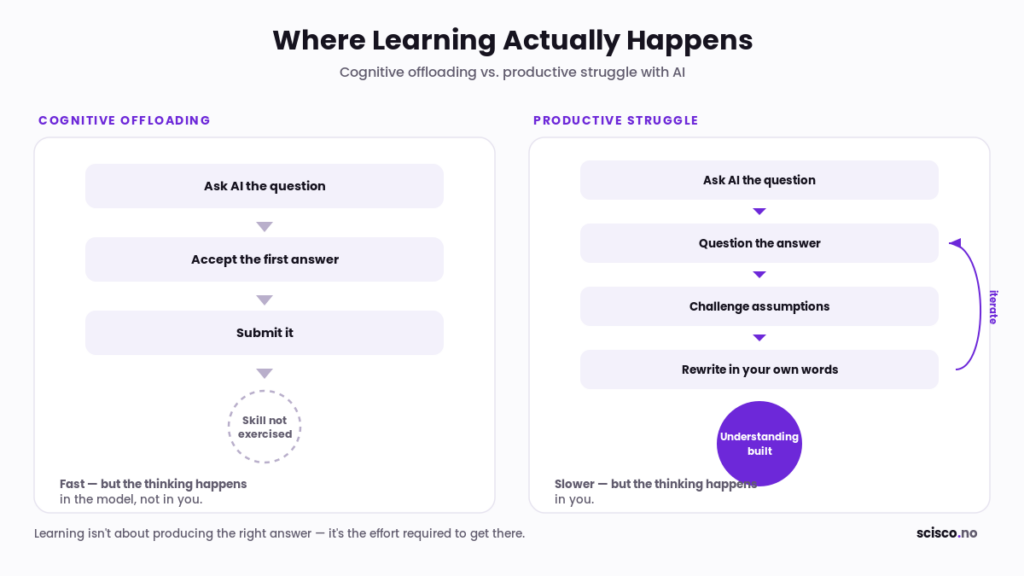
One of the concepts Jade discusses is cognitive offloading. It’s the idea that if we repeatedly let technology handle the difficult thinking, we slowly lose the opportunity to develop those skills ourselves. Learning isn’t just about producing the right answer. It’s about the mental effort required to get there.
I saw something similar during my research. The people who used AI most effectively weren’t those who accepted every answer it generated. They questioned it, challenged it, rewrote it, and used it as a starting point rather than a destination. AI became part of their thinking process instead of replacing it.
Jade also talks about information literacy, and I think this is becoming one of the defining skills of our generation. AI often sounds authoritative, but it can still be wrong. Being able to fact-check information, identify bias, and recognise when something doesn’t seem right is becoming just as important as memorising facts.
AI is reshaping education, but it shouldn’t redefine its purpose. The goal of learning has never been to produce answers as quickly as possible. It’s to develop the curiosity, judgment, and independence that allow us to solve problems long after school or university has ended. Those are qualities no technology should replace.